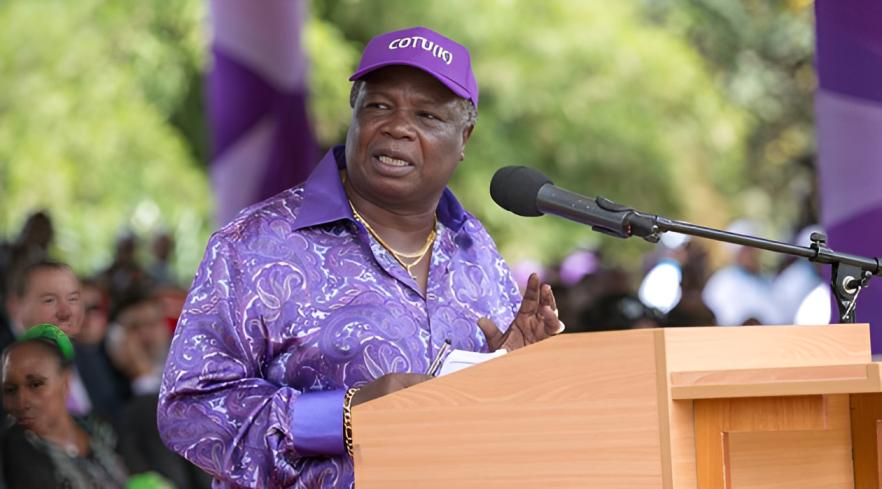
Central Organization of Trade Unions Kenya Secretary General Francis Atwoli has strongly rejected a court petition challenging the union’s recent elections, terming the case baseless and questioning the credibility of the petitioner.
In a statement issued on Wednesday, Atwoli dismissed claims filed by Fazul Mohamed over the March 14 polls held at Tom Mboya Labour College in Kisumu, maintaining that the process was lawful and widely supported by union members.
“Foremost, it is important to note that Mr. Fazul Mohamed, the busybody behind the petition, is neither a member of any affiliate union of COTU (K), nor an official of any trade union, nor a participant in the electoral process,” Atwoli stated.
He argued that Mohamed had no standing to challenge the elections, noting that he did not take part in nominations or engage in any stage of the process. Atwoli went further to question Mohamed’s understanding of union procedures, claiming he lacked the capacity to follow how the elections are conducted.
Atwoli defended the credibility of the vote, pointing to what he described as a strong turnout by delegates. According to him, 92 per cent of eligible representatives took part, far exceeding the required quorum of 51 per cent under the union’s constitution.
“Indeed, this high level of participation of the delegates of COTU (K) is a clear demonstration of the confidence that Kenyan workers and their unions have in the leadership and processes of COTU (K),” he said.
He also addressed concerns raised in the petition about the participation of certain unions. Atwoli clarified that organisations such as KNUT and KUPPET were not fully paid-up affiliates at the time and therefore attended only as observers. He added that KMPDU was allowed limited representation because it had not yet completed its own national elections.
In a sharp escalation of the dispute, Atwoli accused Mohamed of using a fake academic qualification to secure past appointments as chief executive of the NGO Board and the Private Security Regulatory Authority. He warned that such actions risk allowing unfit individuals into positions of leadership ahead of future elections.
The disagreement follows a legal challenge filed at the Employment and Labour Relations Court, where Mohamed is seeking to block the newly elected officials from taking office. The case has been fast-tracked, with a mention set for March 24, 2026.
Court filings indicate that the Registrar of Trade Unions had earlier outlined an election schedule in September 2025. The timeline required affiliate unions to conduct branch elections between January 5 and March 31, 2026, followed by national elections from April 1 to June 30, before COTU (K) could hold its polls by August 30.
Mohamed argues that the federation went ahead with its elections prematurely, before affiliates completed their processes, which he claims made the outcome irregular and unlawful.
The petition further raises concerns about how the elections were conducted, citing issues such as incomplete membership records, lack of an independent electoral body, absence of a voters’ register, and flaws in nomination procedures.
Mohamed is seeking conservatory orders to stop the new leadership, including Atwoli, from assuming office until the matter is heard and determined.
Despite the legal challenge, Atwoli has maintained that the elections were valid and has called on authorities to take action against what he described as attempts to undermine union leadership.
The unfolding dispute now sets the stage for a legal battle that could test the governance and electoral processes of the country’s largest workers’ body.